CensoredDistributions.jl
Primary event censored distributions for Distributions.jl
Why CensoredDistributions.jl?
Fitting observed delays as if they were exact biases the estimate, because the initial event is usually known only to within a window and the longest delays are missing wherever observation stopped.
Primary event censoring and interval censoring are each one call on an existing
Distributions.jldistribution, anddouble_interval_censoredcomposes them with right truncation in the order that keeps the likelihood correct, so it does not have to be derived by hand.The result is still a
Distributions.jldistribution, so it can be fitted in Turing.jl, or anywhere else that takes a distribution, by Bayesian inference or maximum likelihood.Gamma, lognormal and Weibull delays with a uniform primary event use analytical CDFs, and every other pairing falls back to numerical integration, so the common cases are fast and nothing is left unsupported.
Gradients are tested against ForwardDiff, ReverseDiff, Enzyme and Mooncake in CI, so a censored likelihood can be fitted with a gradient-based sampler such as NUTS.
Getting started
For a detailed walkthrough of primary censoring, truncation, interval censoring, and all supported distribution operations (PDF, CDF, quantiles, moments, sampling, fitting), see the Getting Started documentation.
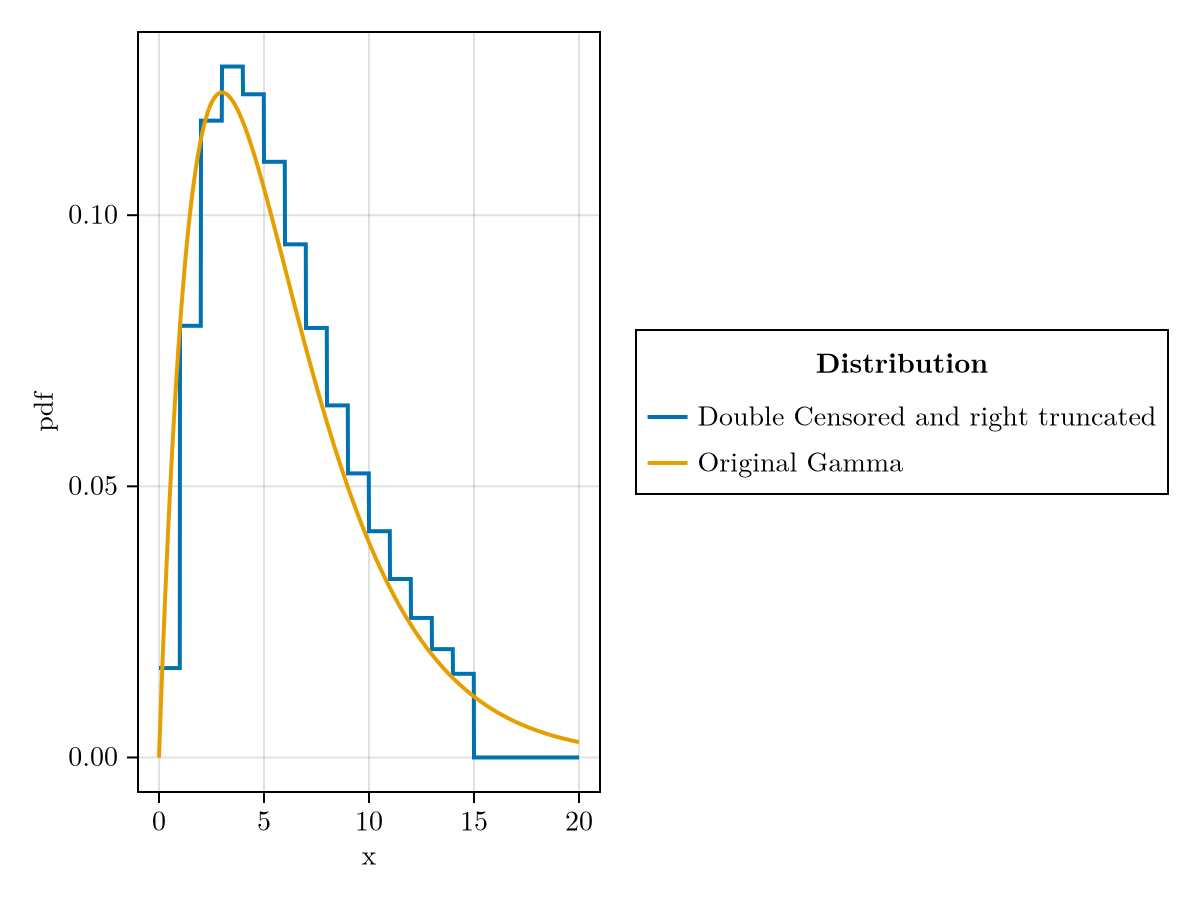
The following example demonstrates how to create a double interval censored distribution (combines primary event, interval censoring, and right truncation (using Distributions.truncated)):
using CensoredDistributions, Distributions
using CairoMakie, AlgebraOfGraphics, DataFramesMeta

CairoMakie.activate!(type = "png", px_per_unit = 2)

# Create a censored distribution accounting for primary and secondary censoring
original = Gamma(2, 3)
censored = double_interval_censored(original; upper = 15, interval = 1)

# Compare the distributions
x = 0:0.01:20
df = vcat(
    DataFrame(x = x, pdf = pdf.(original, x),
        Distribution = "Original Gamma"),
    DataFrame(x = x, pdf = pdf.(censored, x),
        Distribution = "Double Censored and right truncated")
)
draw(
    data(df) *
    mapping(:x, :pdf, color = :Distribution) *
    visual(Lines, linewidth = 2)
)
You can fit censored distributions to data using Turing.jl and any of its supported inference methods. For example, using MCMC for Bayesian inference:
using Turing, StatsBase

# Generate synthetic data from the censored distribution
data = rand(censored, 1000)

# Get counts of unique values for weighted likelihood
values = unique(data)
weights = [count(==(val), data) for val in values]

# Define a Turing model for fitting with weighted likelihood
@model function double_censored_model(values, weights)
    # Priors for Gamma parameters - weakly informative, not centered on true values
    α ~ truncated(Normal(1, 2), 0, Inf)
    θ ~ truncated(Normal(1, 2), 0, Inf)

    # Create the censored distribution
    censored_dist = double_interval_censored(Gamma(α, θ); upper = 15, interval = 1)

    # Vectorized weighted likelihood
    values ~ weight(censored_dist, weights)
end

# Fit using MCMC for Bayesian inference
model = double_censored_model(values, weights)
chain = sample(model, NUTS(), MCMCThreads(), 1000, 2; progress = false)

# Summarise the posterior
summarystats(chain)╭─FlexiSummary (9 statistics) ─────────────────────────────────────────────────╮
│ iter collapsed │
│ chain collapsed │
│ ↓ stat = [mean, std, mcse, ess_bulk, ess_tail, rhat, q5, q50, q95] │
│ │
│ Parameters (2) ── AbstractPPL.VarName │
│ Float64 α, θ │
│ │
│ Extras (14) │
│ Float64 n_steps, is_accept, acceptance_rate, log_density, │
│ hamiltonian_energy, hamiltonian_energy_error, │
│ max_hamiltonian_energy_error, tree_depth, numerical_error, │
│ step_size, nom_step_size, logprior, loglikelihood, logjoint │
│ │
│ Summary │
│ param mean std mcse ess_bulk ess_tail rhat q5 … │
│ α 1.9755 0.1037 0.0044 576.3253 458.6644 0.9997 1.8005 … │
│ θ 3.0457 0.2228 0.0097 582.8069 449.3136 0.9997 2.7221 … │
╰──────────────────────────────────────────────────────────────────────────────╯Or fit using MAP:
map_result = maximum_a_posteriori(model)ModeResult
├ estimator : Turing.Optimisation.MAP
├ lp : -2525.0694178581493
├ params : VarNamedTuple with 2 entries
│ ├ α => 1.9842856569508684
│ └ θ => 3.0060866243624558
│ linked : true
└ (2 more fields: optim_result, ldf)Relationship to Distributions.jl
Both CensoredDistributions.jl and Distributions.jl's built-in censored() function handle censoring, but they address different types of uncertainty:
These approaches complement each other - you can apply observation limits to distributions with event timing uncertainty when both types of censoring affect your data.
CensoredDistributions.jl also works well with truncated() from Distributions.jl and supports both primary event censoring (initial event timing uncertainty) and secondary event censoring (observation window effects).
Related packages
ComposedDistributions.jl is the general composition layer split out of this package, building event trees from chains, branches and competing outcomes, with a censored delay usable as one leaf.
ConvolvedDistributions.jl convolves independent delays into sums, differences and products, and its
convolve_seriesdeliberately leaves discretisation to this package rather than binning a continuous delay itself.ModifiedDistributions.jl rescales, weights and hazard-modifies a distribution, and those modifiers wrap a censored distribution the same way they wrap any other.
Where to learn more
Want to get started running code? Check out the Getting started tutorials.
Want to understand the API? Check out our API Reference.
Want to chat with someone about
CensoredDistributions? Post on our GitHub Discussions.Want to contribute to
CensoredDistributions? Check out our Developer Documentation.Want to see our code? Check out our GitHub Repository.
Supporting and citing
If you would like to help support CensoredDistributions.jl, please star the repository as such metrics may help us secure funding in the future.
If you use CensoredDistributions.jl in your work, please cite it:
@software{CensoredDistributions_jl,
  author       = {Abbott, Sam and Bayer, Damon and Brand, Sam and DeWitt, Michael and Lemaitre, Joseph},
  title        = {CensoredDistributions.jl},
  year         = {2025},
  doi          = {10.5281/zenodo.18474652},
  url          = {https://github.com/EpiAware/CensoredDistributions.jl}
}
Contributing
We welcome contributions and new contributors! We particularly appreciate help on identifying and identified issues. Please check and add to the issues, and/or add a pull request and see our developer documentation for more information.
Code of conduct
Please note that the CensoredDistributions project is released with a Contributor Code of Conduct. By contributing to this project, you agree to abide by its terms.